
Design better battery cell packs leveraging detailed geometrical cell specifications and cell performance simulation.
Simcenter Battery Design Studio (BDS) is Siemens’ dedicated tool for digitally validating and optimizing lithium-ion cell designs early in development. It combines detailed geometrical cell definition with multi-level performance simulation, enabling engineers to explore design variants quickly, understand real-world behavior, and make better trade-offs among energy density, power, cost, safety, and lifetime before moving to pack- or system-level work.
Core Capabilities
- Detailed cell geometry and materials: Parametric templates cover common formats (cylindrical, prismatic, pouch, stacked-plate, and spirally wound cells), with support for electrodes, separators, collectors, tabs, and packaging. An extensive material database (active materials, binders, conductivity aids, electrolytes, etc.) plus a property editor lets users build or customize models rapidly.
- Multi-level performance modeling:
- Physics-based macro-homogeneous models provide insight into electrochemical mechanisms (voltage loss, concentration effects, heat generation, rate-limiting physics).
- Equivalent RCR (resistance-capacitance) circuit models deliver computationally efficient empirical behavior, well-suited for frequent charge/discharge duty cycles and system studies. Models can be run in 1D or 3D modes, with selectable discretization to balance speed and fidelity, and can couple electrochemical performance with thermal response.
- Design exploration: Built-in parameter sweeps and integration with HEEDS support multi-objective optimization of cell geometry, materials, and performance. Automated workflows allow rapid assessment of many variants to maximize performance, optimize material usage, reduce mass, or minimize impedance growth.
Seamless Integration with STAR-CCM+ and System Simulation
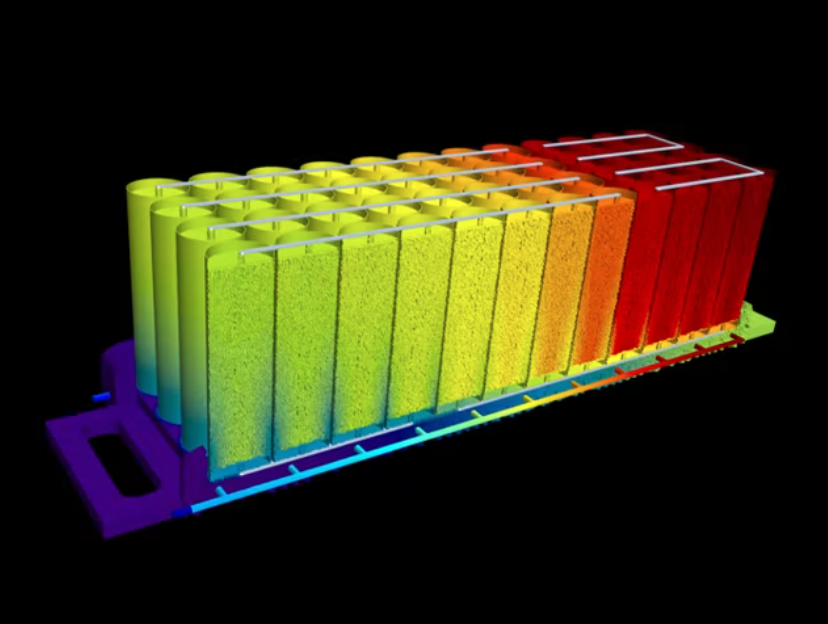
A key strength for thermal and fluids engineers is the direct link to pack- and system-level simulation. BDS exports Text Battery Model (TBM) files that transfer cell geometry, electrochemical models, and thermal characteristics into Simcenter STAR-CCM+. This enables accurate 3D electro-thermal CFD of modules and packs—including cooling channels, bus bars, insulation, and casing—with automatic meshing and transient duty-cycle analysis. Cell-level data can also feed 1D system tools such as Simcenter Amesim for pack pre-sizing and vehicle- or powerplant-level studies. Encrypted cell files support secure collaboration across the supply chain while protecting IP.
Real-World Impact
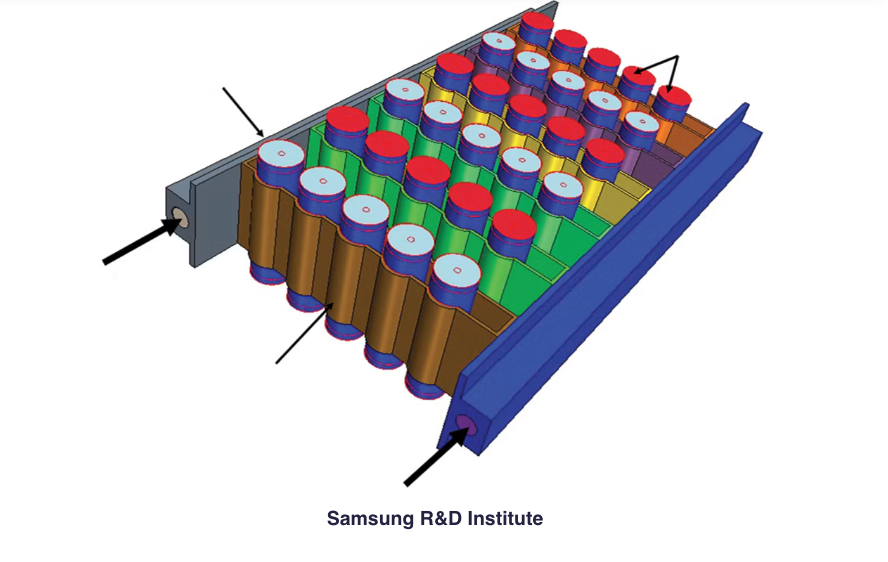
In a published case study, Samsung R&D Institute used Battery Design Studio with STAR-CCM+ to develop and validate a liquid-cooled thermal management system for Li-ion packs. Electrochemical inputs from BDS combined with 3D conjugate heat-transfer simulation produced temperature predictions that matched experiment with greater than 90% accuracy. The approach delivered a low-cost, effective cooling strategy (average hottest-to-coldest cell delta of only 0.5 K under the tested conditions) without relying on exotic materials, demonstrating how early cell-level insight improves pack-level safety and efficiency.
Why It Matters for Battery Simulation Work
Battery Design Studio front-loads critical design decisions. By rapidly characterizing cells and feeding high-quality electrochemical and thermal data into STAR-CCM+, teams can explore more concepts, reduce reliance on physical prototypes, identify thermal risks earlier, and deliver safer, higher-performing packs. It is particularly valuable for organizations developing EV, energy-storage, or high-power battery systems that need a practical bridge between cell chemistry/geometry and full-pack CFD thermal management.