Design Exploration
Design Exploration
Design exploration tools are efficient means to predict the influence of input parameters on quantities of interest in a simulation. It provides the sensitivity of objectives (cost functions) with respect to input parameters including design variables and values of boundary conditions. Examples to which the adjoint method can help provide answers to parameters including:
- Sensitivity with Respect to Design Parameters
- Sensitivity with Respect to Boundary Parameters
- Surface Sensitivity
- Adjoint Error Estimation
- Adjoint Topology Optimization
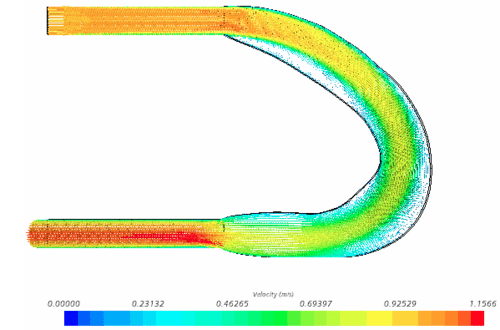
The topology optimization method is based on a level set approach. Unlike the traditional porosity method, this approach doesn't just block the flow from the cells with source terms. It also defines a moving interface around the predicted flow path.
Design Explorer Tools
Design Manager & Adjoint Topology Optimization
Totalsim Workflows in Computational Fluid Dynamics as Topology Optimization and Generative Engineering:
For running an adjoint topology optimization you merely need to start from the envelop in which your design will be located. This naturally gives you the spacing constraint satisfaction. This method will chisel away all the parts of your geometry that hinder the set cost function characteristics. It is turning them into solid and defining the shape that allows the optimal flow path.
Explore TotalSim Adjoint Topology Optimization solutions:
Benefits We Provide
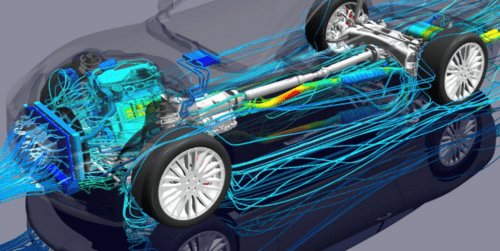
Working with virtual modeling and simulation of fluid flows allows you to accelerate your design process using software such as Star-CCM+ or OpenFOAM. This reduces the number of physical prototypes and testing, while still evaluating all necessary conditions. Our engagement ranges from CFD consulting, to training, to customized workflows to meet your specific needs.
Whether you're testing marine design, marine applications, investigating the effects of flooded compartments, our personalized simulations and apps provide valuable insight. Working with TotalSim's CFD Design Exploration Services will put you years ahead of the competition, while lowering your costs and optimizing your designs. Let us help you reach your goals efficiently and accurately.
Explore Our Topology Optimization Capabilities
Adjoint Shape Optimization
Adjoint: Mesh Sensitivity
Our Adjoint Shape Mesh Optimization workflow helps our customers to calculate the contribution of a gradient to shape optimization. A typical application of an adjoint flow analysis is to use the computed gradients in a shape optimization study with respect to a chosen cost function. In Simcenter STAR-CCM+, simulation operations allow you to construct an automated pipeline for optimization studies without any need for Java macros.
Our workflow helps do the following:
- Optimize a Surface Based on Mesh Morphing Capabilities
- Maximize or Minimize an Engineering Quantity
- Optimize Within the Parameters of the Geometry
- Identify the Factors that Influence the Engineering Quantity of Interest
Adjoint: Surface Sensitivity
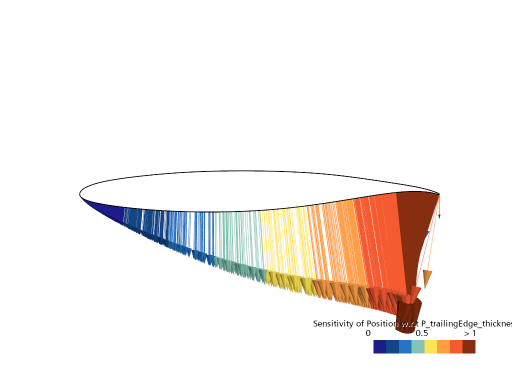
Our proprietary workflow for an Adjoint Shape Surface optimization study requires a repeated sequence of steps. The mesh is deformed according to a deformation field derived from the surface sensitivity. This process helps our customers do the following:
- Optimize a Surface
- Maximize or Minimize Engineering Quantity, like Pressure Drop or Forces
- Optimize Within the Parameters of the Geometry
- Identify the Factors that Influence the Engineering Quantity of Interest
- Ensure a Smooth Shape Optimization using A Global Filter Radius as A Surface Sensitivity
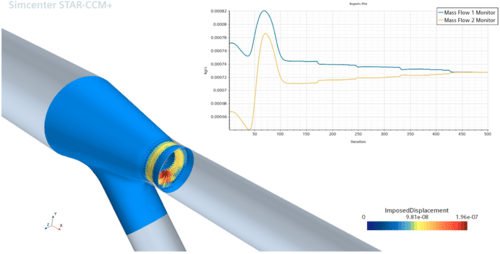
Adjoint Shape Optimization: Surface Mesh Morphing
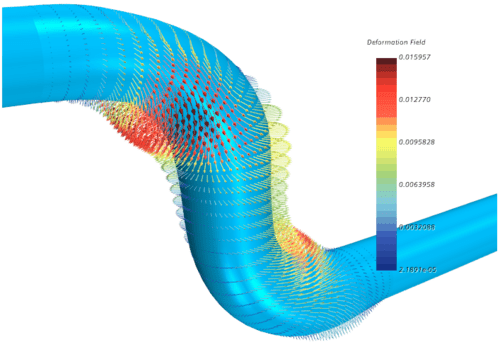
Our workflow provides the adjoint solution for shape optimization as a method for finding modified designs that improve performance and efficiency. Our workflow helps do the following:
- Shape Optimization Where the Deformation is Accounted for by Morphing the Surface
- Optimize Position of the Surface is to Maximize/Minimize the Cost Function of Interest
- The Morph Surface Mesh Operation Allows you to Deform the Entire Part or Individual Part Surfaces of the Geometry and Re-run the Volume Mesh after Every Optimization Cycle
- Avoid A Bad Quality Mesh when Dealing with Large Displacements
- Achieve A Uniform Mass Flow Split Between Outlets
Design Explorer Tools
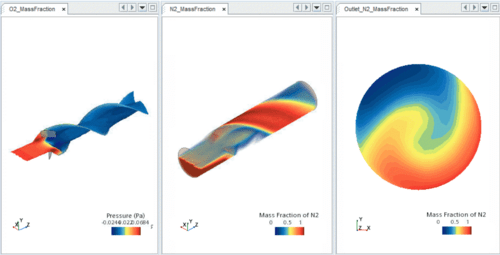
Optimizing a Static Mixer
Our workflow supports the multiple-objective tradeoff. It can be used in a variety of industrial equipment and processes.
For example, in this application a mixture of oxygen and nitrogen is passing through a static mixer. We can help our customers with the following:
- Searches for the Combination of Inputs that Gives the Best Overall Result Among Competing Objectives
- The Aim of the Optimization is to Make the Mixture as Homogeneous as Possible at the Outlet
- Minimize the Pressure Drop Across the Pipe
- Modify the Values of 3D-CAD Design Parameters
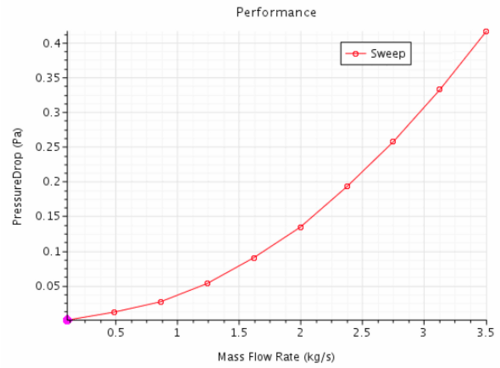
Design Sweep of a Static Mixer
Our workflow supports the multiple-objective tradeoff. It can be used in a variety of industrial equipment and processes.
For example, in this application a mixture of oxygen and nitrogen is passing through a static mixer. We can help our customers with the following:
- Searches for the Combination of Inputs that Give the Best Overall Result Among Competing Objectives
- Make the Mixture as Homogeneous as Possible at the Outlet
- Minimize the Pressure Drop Across the Pipe
- Modify the Values of 3D-CAD Design Parameters
- Performance Plot Updates as the Optimized Design is Evaluated with Different Mass Flows at the Inlet
- Impinging Jets Located Over A Surface Optimal Array Configuration for Heat Transfer Applications
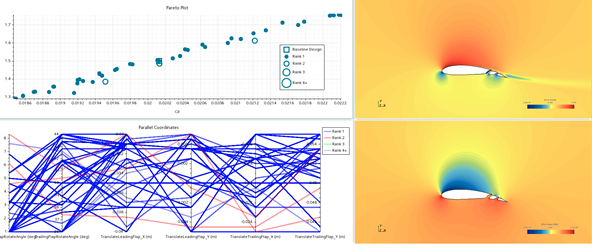
Pareto Optimization: 2D Airfoil Design
Our workflow allows you to run design optimization studies with multiple competing objectives. When running an optimization study with two competing objectives, the optimal design is not unique. Rather, a set of optimal designs (called a Pareto front) expresses the trade-off relationship between the objectives. Each design in the set is the optimum in one objective for a given value of the competing objective. We help our customers run a large number of simulations to explore many designs at the same time.
Our workflow accomplishes the following:
- Automatically Modifies the Values of the Design Parameters and Evaluates the Resulting Engineering Quantities of Interest
- Set-up Analysis Either to Minimize or Maximize the Engineering quantity of Interest
- Modify the Values of 3D-CAD Design Parameters
- Explore Multiple Designs at the Same Time
Surrogates
Surrogates: Reliability
Surrogate models, also known as response surface models (RSM), allow you to capture the response of a system to its inputs in a form that can be queried by other computations in separate studies. Surrogate models are appropriate when performing robustness studies because they cover a large number of permutations around a chosen design.
Our proprietary workflow allows us to help you do and identify the following:
- Employed to Assess the Influence of Installation and Manufacturing Tolerances on the Performance of A Design
- Running Full Simulation for Each Permutation
- Sequence of Studies: Optimization Study, Design of Experiments (DoE) and Robustness and Reliability Study

Design Manager & Adjoint Topology Optimization
Part-Replacement Using Design Manager
Our part-replacement methodology is able to help our customers in industrial situations run standard flow analyses on different product configurations for regulatory requirements. Through this methodology we can assist with automating analyses.
Our workflow does the following:
- Replace Part Operation and File Global Parameter to Explore Multiple Designs of A Particular Part for A Design Manager Study
- Evaluate Regulatory Requirements
- Identify Deficiencies on the Design
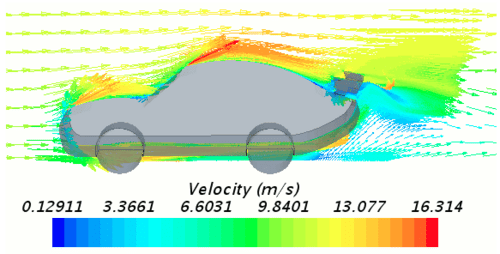
Adjoint Topology Optimization: Channel Flow With Minimized Pressure Drop
Topology optimization can aid in the design of components found in or ground transportation vehicles by improving performance and efficiency.
Our workflow accomplishes the following:
- Determines the Optimal Distribution of Material Within A Domain in Order to Meet A Single Objective and Any Constraints Placed on it
- Determine the Optimal Flow path of Water Between Two Parallel Channels by Minimizing the Pressure Drop Between Inlet and Outlet